
Welcome to an interfaith celebration of the holidays as a pseudo-Christian/Atheist family! How do we celebrate our family’s traditional holidays after deconstruction? I’m glad you asked! I’ve realized new ways the Advent season is still meaningful to me as an ecumenical, contemplative mystic coming out of Christian evangelicalism. As a secular humanist and since it was important to me, Daniel supported the idea of exploring the weekly Advent themes from our different perspectives.
Here is the second entry in our Advent series, which for Christians is the period of four weeks before Christmas. Traditionally, the second Sunday in Advent celebrates Peace and this year it falls on December 10. This reflection on Peace is written by Daniel, with a focus on encouraging individuals to find meaning and purpose in their lives through reason, ethics, and the pursuit of human well-being.

—
I heard the bells on Christmas day
I Heard the Bells on Christmas Day, Henry W. Longfellow, 1863
Their old familiar carols play;
In music sweet the tones repeat,
“There’s peace on earth, good will to men.”
I thought how, as the day had come,
The belfries of all Christendom
Had rolled along th’ unbroken song
Of peace on earth, good will to men.
And in despair I bowed my head:
“There is no peace on earth,” I said,
“For hate is strong, and mocks the song
Of peace on earth, good will to men.”
Some of my friend and family have asked me recently, if I am now a secular humanist (if I now no longer believe in anything supernatural), why bother with Christmas? Despite what some might think, I am actually still a big fan of Christmas. After all, growing up it was never the Christmas story that made me love this season; it was the feeling. The anticipation in the air, the ritual, the music and the food and the time with family – this was always Christmas to me, and I am still eager for the season every year.
This year, my wife and I have been talking about Advent and what the season of Advent might look like for us now that neither of us maintained an orthodox Christian belief. Both of us are strong proponents of shared meaning and ritual, and the Advent season seemed to be the perfect opportunity to explore this – especially a concept as universal as peace, which comes up all over the place at Christmastime. Unfortunately, peace seems hard to come by these days, whatever your belief system is.
You don’t even have to turn on the TV to see evidence of conflict – just lift your phone and take a look at your social media platform of choice. The ongoing war in Ukraine, the ongoing conflicts in the Middle East, and countless politicians, warlords, and self-proclaimed “peacemakers” clamoring for blood on a regular basis flood our feeds and our minds. It is an overwhelming series of very un-peaceful events going on in the world around us. During times like these talking about “Peace on Earth” seems cliché, almost in bad taste, even on Christmas. Are we hopelessly out of touch to talk about peace at times like these?
When I think about peace during the Advent season, I don’t think about the birth of Jesus. I don’t think about how bad things are in the world today. I don’t even think about the hoped-for end of conflict in our time.
I think about the Western Front on December 25, 1914.
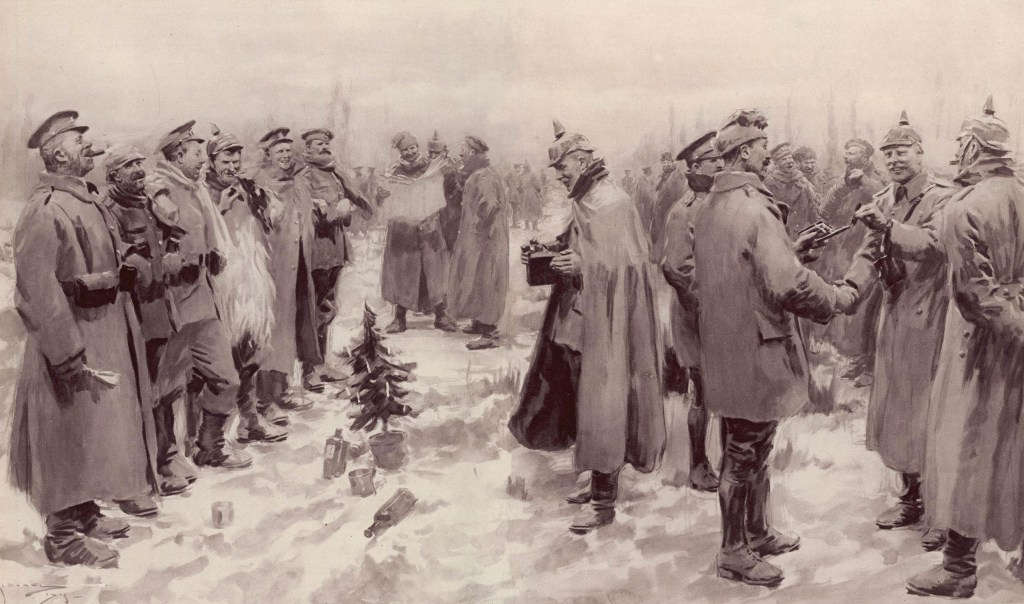
The Christmas Truce
The story of the “Christmas Truce” seems like one of those tales that grows with the telling, surely too good to be true. Thankfully we have considerable evidence that it actually occurred – that on Christmas Day in 1914, all along the front lines of the Western Front, there was an unofficial truce. German, British, and French soldiers left their trenches and entered No Man’s Land, that blasted wasteland of mud and barbed wire, and celebrated Christmas together. They shared food, sang songs, even played games of football. The firsthand reports of that day – and there are many – paint a picture of a time set apart from the war that had become so devastating.
— “The Germans left their trenches and walked without their rifles half-way across the field to where we were entrenched. There was not a shot fired. Some of our chaps then got out and went to meet the German soldiers. You should have seen them shaking hands with our boys and handing them smokes. Both sides walked and talked with one another as if there was nothing the matter. Later on our lads helped the Germans to bury their dead and sang over the graves. It was a sight you could never forget.” – Lance-corporal George Yearsley, January 2nd, 1915.
The stories quickly swept Europe, and to some seemed to be an indication that the Great War was coming to an end. After all, the soldiers themselves on both sides of the Front could scarcely name the reasons why they were fighting to begin with. Bridging the gap on Christmas Day brought peace to the forefront of everyone’s’ mind, and as a result some soldiers could no longer continue fighting.
— “I have heard one such story from a wounded French soldier who has just arrived at a Parisian hospital from the front. He said that on the night of December 24th, the French and Germans at a particular place came out of their respective trenches and met halfway between them. They not only talked, exchanged cigarettes, &c, but also danced together in rings… The French and German soldiers who had thus fraternised subsequently refused to fire on one another and had to be removed from the trenches and replaced by other men.” – A Paris correspondent of the Manchester Guardian, January 6, 1915
Due to the advances in technology, World War I was the most devastating conflict to that point in history. Cavalry charges and “gentlemanly” war were long past; now warfare had become the domain of machines that could inflect loss of life on a previously unimaginable scale. For the rich and powerful who were running the war on both sides, this tentative peace was a completely unacceptable situation. Those in power made further overtures of peace between soldiers on the front impossible, as described in an article less than a month after the truce:
— “War is no sport…and we are sorry to say that those who made these overtures or took part in them did not clearly understand the gravity of the situation. These considerations did not escape the attention of the army authorities, and the newspaper states with great satisfaction that an army order issued on December 29th forbids for the future similar fraternisation and any rapprochement with the enemy in the trenches. All acts contrary to this order will be punished as high treason.” – an article in the in Staffordshire Sentinel, January 9, 1915
We can learn quite a bit about human nature from the Christmas Truce – even in the worst hardships we want peace. We are hardwired for peace, for collaboration, for altruism; it’s in our behaviour and our psychological makeup and deep, deep down in our DNA. When facing each other in the trenches surrounded by mud and blood those young men wanted nothing more than to make peace with each other. It was more powerful, more important men, men far away from the realities of combat, sleeping in warm beds with no thoughts of trenchfoot or exploding shells, who gave the orders for the fighting to continue. These men never had to look the enemy in the eye, never had to face the consequences of their decisions. A few lines drawn on a map, a few orders given, and tens of thousands died. Is it any wonder that after the war so many soldiers penned savage criticisms of their commanders and politicians? “Lions led by donkeys” was a common phrase used in those times, though it fails to communicate how badly those lions wished they could have gone home.
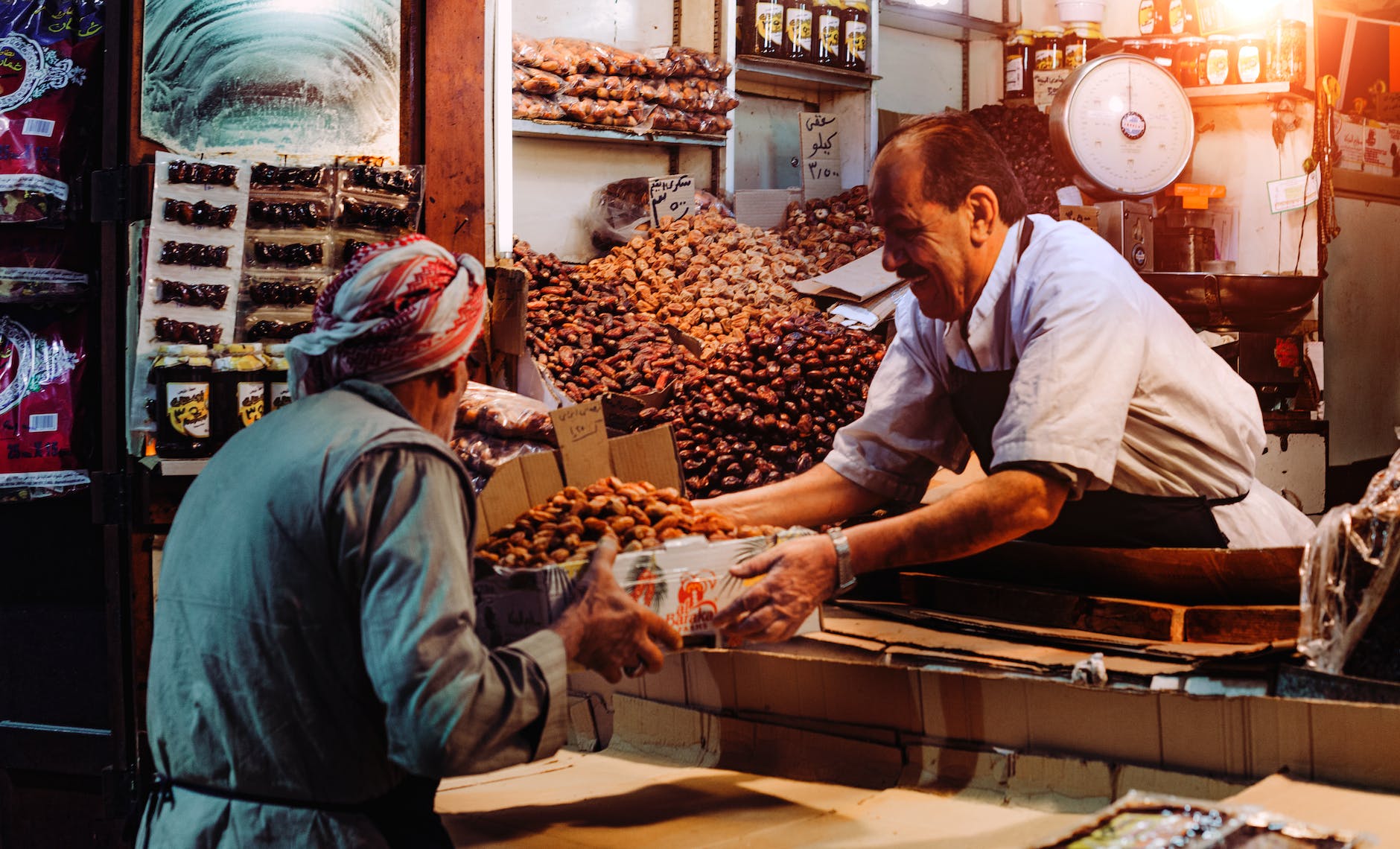
Is Peace Achievable?
Thankfully, the world has moved on from the globe-spanning conflicts of the two World Wars, at least for now. And though it may be hard to believe as our phones, televisions, and computers bring us visions of conflict every day – the facts are inescapable. Fewer people live under the threat of violent death than ever before, especially when we consider all forms of violence outside of mass conflict. There are factors that create greater opportunities for lasting peace in our world, and these factors – including economic development, education, women’s empowerment, expanded global trade, and improved democratic governance on an international scale – have been growing worldwide. Cognitive psychologist Steven Pinker argues that humanity has been growing steadily more peaceful for thousands of years, and that this trend is likely to continue.
And yet, it is not enough. Not a person on this planet would try to pretend that we have peace on earth. It is not enough that we are slowly becoming more peaceful as a species; not when conflict still defines so much of our daily lives – from the wars in distant countries to the arguments we get into on Facebook. There is so much yet to be done. And still, as it was a century before and indeed perhaps in every century before, it is those in power who benefit from the fighting real or virtual, and who quietly work to ensure conflicts continue so they may profit.
In a pluralistic world filled with Christians, Muslims, Secular Humanists like me, and…. whatever my wife is*, peace is not just the absence of conflict but the active pursuit of harmony, understanding, and shared well-being among individuals and communities. If we let it, the Advent Week of Peace can serve as a reminder that peace is not a passive state but an ongoing effort that requires collaboration, dialogue, and a commitment to common goals. It means recognizing and capitalizing on the collaborative nature of humanity. This will require us to set aside our differing beliefs and focus on our common values. It will require us to be active creators of peace, not passive receivers. In the words of author and Unitarian Minister Robert Fulgham, ““I do not want to know what you will hope for. I want to know what you will work for. I do not want your sympathy for the needs of humanity. I want your muscle. As the wagon driver said when they came to a long, hard hill: ‘Them that’s going on with us, get out and push. Them that ain’t, get out of the way’.”
If we really do want peace on earth, we have to roll up our sleeves and go to work. Ordinary people like us are the ones who must leave the trenches behind and find each other in No-Mans Land, no matter what those in power want us to fight about. So if you want to light a candle for peace this week, you are welcome to the work – there’s more than enough to go around.
—
*Sara: I absolutely and cheerfully accept this as an cheeky and appropriate characterization of my religious non-affiliation at the moment. Touché, Daniel.
 The Prairie Thistle
That’s beautiful!