
Starting today, Meta is blocking news for Canadian users on its platforms, including Facebook and Instagram, as the Canadian Government works out implementation for recently passed legislation which would see social media giants pay for access to news content.
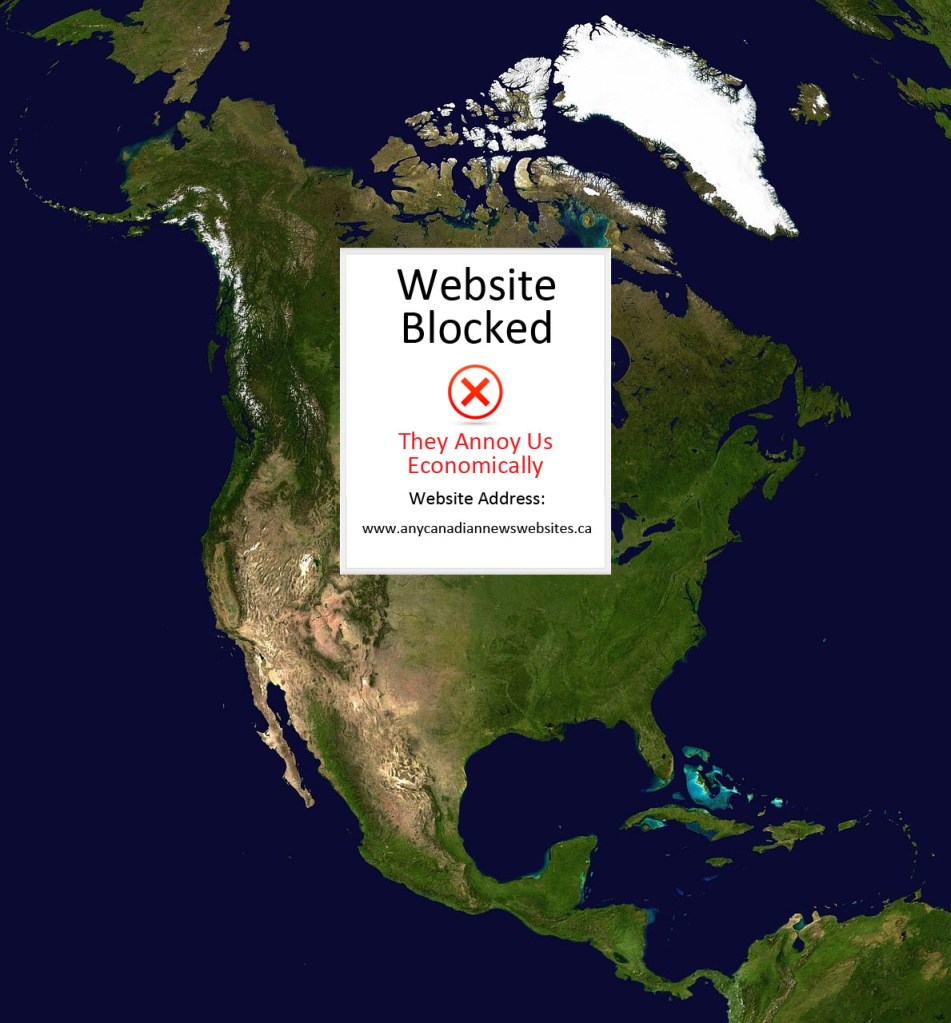
From what I understand, the new law passed by the federal government in Canada is intended to protect the Canadian news industry and online giants Meta and Google are pushing back.
As a small town freelance writer, it’s rare (not never, but rare) for me to feel directly impacted professionally by international news. For the same reason, I am most often and thankfully spared the vitriol thrown at journalists these days. I have encountered a few conspiracy theorists in the past few years as I’ve been active as a reporter in my community (I would guess, we’ve got more than our fair share out here in southeast Manitoba compared to the national average). And, yes, I still love where I live.
I’ve been watching this issue develop with great interest and, let me tell you, I’ve got some thoughts to share.
First, there are two aspects I’d like to make sure everyone is aware of:
- The Canadian media industry in general is very different in Canada compared to the states as it is afforded much protection from the CRTC (the general public knows this, no?).
- The Canadian news media is afforded this same support through its regulatory body and federal funding – this is why we have the CBC. CBC News is especially unique and has more similarities in its setup to the BBC than compared to the US’s NBC.
All right, let’s dig in.
What’s Happening to News Media?
With the rapid growth of digital media, online and social media companies began to dominate the world’s publication of news. This is a major shift in human communication and idea-sharing akin to the invitation of the printing press and subsequent news media development (the rise of the first newspapers across western culture which completely changed business the world over). Back then, the powerful economic changes driven by advertising dollars through these media platforms was new and had staggering economic impact. And so it is and does now.

In the last 25 years, traditional news media (I’m including television) needed to change or die. And so we’ve seen it change, bending to advertising dollars, becoming more sensational and click-bait-y in nature, with some conglomerates bending to big industry pressures in order to remain viable. We’ve also seen it die: smaller news organizations in both Canada and the US have lost ad revenues to online sources forcing them to reduce print publication, transition to online publication, and/or eventually close entirely.
Remember, Canadian news media is different than the US. Even though a case can certainly be made that Canadian news media has followed suit in becoming more partisan or sensationalist, the extent of its loss of integrity to ad dollars pales in comparison with the US media climate. Why? Not because we’re so pious in our ability to say “no” to the influence of ad revenue or have such protection afforded us through the CRTC, but really simply put: we’re just that much smaller. Yep. We’re small potatoes. Tiny. Nigh inconsequential when the numbers stack up of viewers, clicks, and news/ad industry dollars.
Google and Meta are social media platforms that have come to arguably dominate the propagation of news stories. Even if they are not writing the stories themselves, news publishers have become increasingly dependent on the sharing ability made possible through these online platforms to draw viewers back to their own independent publications. The independent publication receives ad dollars; the social media companies receive a lot of ad dollars.
What is the Canadian Government Doing?
Google and Meta have been asked by the Canadian Government to consider entering into agreements with Canadian news publishers to pay them a fee for the news content that is getting clicked on, shared, commented on, and otherwise interacted with. So it’s kind of like they are being asked to ‘subscribe’ to the content that they are benefiting from, content which, for all intents and purposes, they have been receiving mostly for free.
As the Canadian news industry has been suffering, they have asked for the Canadian Government to apply pressure politically and now legally. While political pressure and diplomacy have likely have been happening, it has likely not made a lot of waves and so now we are seeing a new international law pass which makes it illegal for online media sharing platforms like Google and Meta to post or share Canadian news content without compensation to those Canadian companies.
The letter of the law corrects the current imbalanced flow of ad revenue. Canadian companies creating content would receive more compensation for how often their stuff is viewed. The intent of the law is in keeping with the longstanding precedent set by the Canadian Government in its commitment to exposing Canadians to uniquely Canadian content which informs our uniquely Canadian identity. It does not aim to exclude US content or censor what news Canadians can access. It aims to bolster Canadian industry and protect Canadian cultural identity.
In this way, it should become apparent why international politics and law could become super interesting to the average Canadian at this point in history – if you have a social media account on Meta (Facebook or Instagram) or use Google, your experience could drastically change. Why? Because Google and Meta are resisting the Canadian law.

What are Google and Meta Doing?
Although Google and Meta have obviously responded to some Canadian diplomatic politicking by signing some agreements with some Canadian news media, they have not signed on to the extent the Canadian news industry requires to remain viable to Canadians. Hence the new Canadian federal law.
Google and Meta have stated they will not follow the law, so they will block Canadian news media content from their algorithms. Without Canadian news media content or shareable links, the two companies will largely function as per normal. Remember, compared to Canadian news media companies, we are ants and Google and Meta are giants.
It is not necessarily in Google and Meta’s best economic interests to pander to Canadian news media. It isn’t out of the question to strike financial agreements with our news companies, but it isn’t necessarily going to hurt them if they choose not to. Why choose to lose even a small amount of revenue stream to their Canadian neighbours whey other news media sources will continue to share? Truly, Canadians may not even notice if newsmakers like CBC, CTV, and Global are suddenly missing from their Google search engine or Facebook news feed. (Especially Canadians who read American international news sources like NBC, CNN, CBS, BreitBart and more. Also, Canadians who read other international news certainly may not notice change – but keep in mind that the demographic of Canadians who read international news like Reuters, the Associated Press, London Times, Al Jazeera, et all typically do read the aforementioned Canadian news sources.)
It is also important to note that what happens here with Canada’s law and the American companies’ response to it has repercussions across the world stage. Google and Meta don’t just stand to lose a trivial amount of income to Canada; the situation sets a possible precedent for losing income to other countries’ news organizations the world over. And that is certainly a much bigger chunk of dollars.
Other countries are also facing what Canada is facing. Bloomberg news reported in July that Australia’s government successfully bargained with Google and Meta, leading to more than a projected annual $200 million injection to their news media industry. This was felt in an immediate economic boom as newsrooms expanded and journalism job postings went up.
In this way, maybe there is a hope that Google and Meta will respond to precedent, but they certainly do not have to – and do not want to.
Since the passing of the Canadian law, the Government has slowly been preparing the details of the law. And Google and Meta have been preparing the necessary algorithms to shut out Canadian content. While it could take months to impact the average social media user in Canada, Meta has already made the move to begin blocking Canadian users from accessing Canadian news starting today.
What Happens Now?
Literally, the world is watching and waiting. Without an increase in revenue agreements, Canadian news media will continue to shrink. Our user experiences on Google and Meta will change – somewhat noticeably, but depending on where/how you interact with news.
If you are interested in accessing news made in Canada for Canadians, you will need to be more intentional. Here are some websites you might be interested in referencing to find Canadian news:
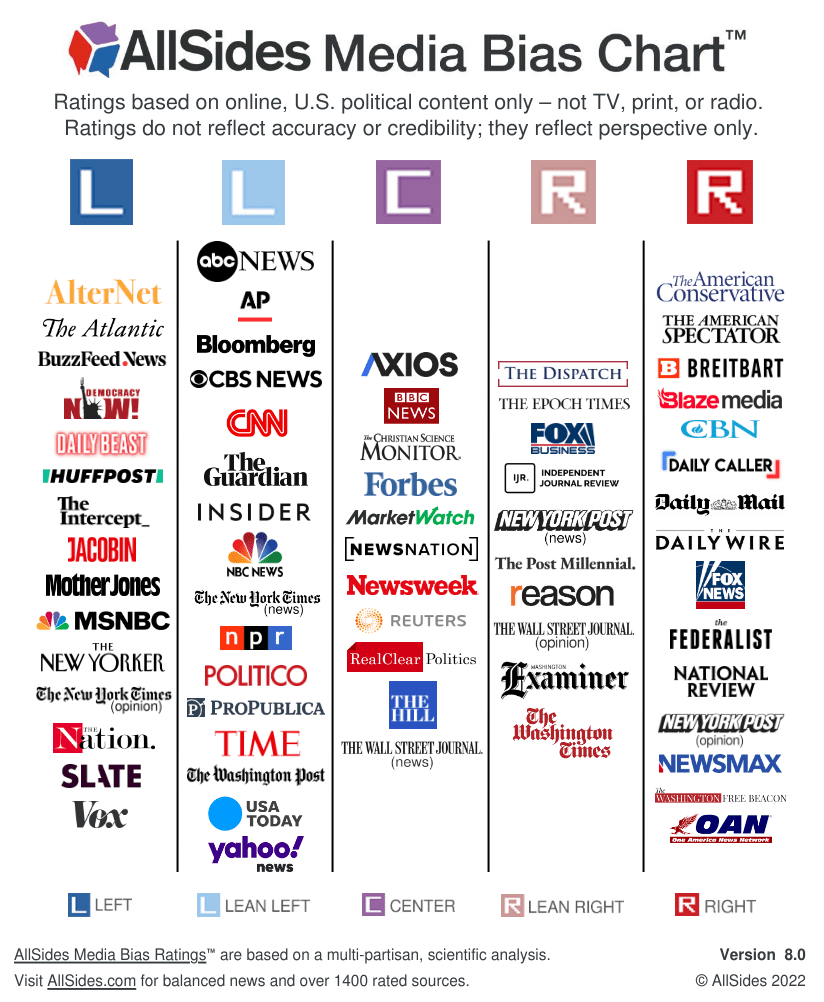
And here’s an oldie, but a goodie – the All Sides Media Bias Chart – which is a good one to have in your pocket if you consume American and international news media and need a reminder to be cognitive of the bias of the media you’re consuming:
So stay informed. Be aware of if you are one of the users now blocked from accessing Canadian news on Meta. And keep monitoring the progress of the Canadian Government toeing a very tenuous line of legal power vs. economic and cultural best interests.
Some government officials have likened this situation to a new form of warfare; as each country’s economic interests are weighed, our national identity hangs in the balance. I despise the general overabundance of war ascription, but in some ways, a case for a threat to national autonomy is legitimate. To some, the letter and the intent of our national laws are incredibly important considerations our Canadian authorities must become familiar with, and fast, to arm themselves in defence of what we know as Canada. Other countries facing the same economic and cultural impact of dealing with online news and social media are looking to us for international leadership.
Some Canadian officials only see how small potatoes we are in all of this. They have publically expressed regret over the passing of the new law (did it actually pass under their noses undetected?) and had been looking for ways to either walk it back completely or significantly neuter actual international legal enforcement. As it passed, there’s not much they can do, but watch and wait.
So, too, does the average Canadian wait and watch – albeit, likely watch less Canadian news very soon.
Makes me wonder if my own stories from the small town newspaper will be shareable on Facebook in a few months time? We will have to see.
 The Prairie Thistle